THIS WEEK · RESEARCH FEATURE 01 · 25 SEPTEMBER 2026
THE QUESTION
Can China turn dispersed AI compute into a usable national market?
China has built large amounts of computing capacity across regions, but spare capacity is not automatically useful to a distant customer. This feature examines the missing market layer: how users find resources, test compatibility, move workloads and data, provision environments, schedule jobs and ultimately pay for compute across independent pools.
25 September 2026China AI EvolutionPrimary-source led~16 min readUpdated through 26 September evidence
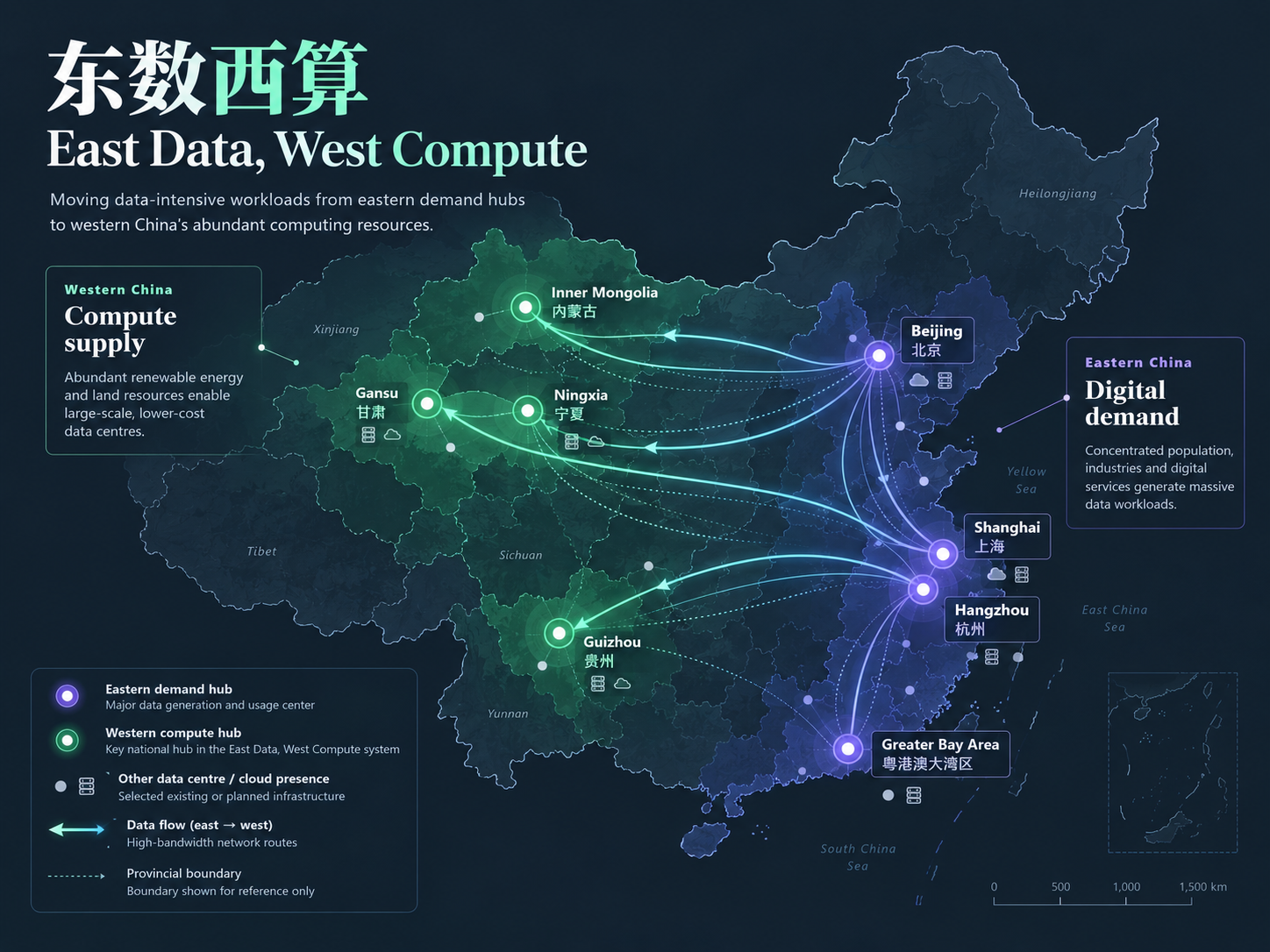
East Data, West Computing — the geography in one frame. The 2022 policy logic was to use western China’s greater resource availability — especially renewable energy — to host more data-centre capacity and serve suitable eastern workloads. It did not assume that western China already possessed abundant compute. Route lines and small white infrastructure symbols are editorial illustrations, not live network paths. Use the sourced interactive map below to explore the official clusters and company locations.
The 2022 geography was the starting point, not the finished system. It identified where new capacity could concentrate and which types of workload might move. It did not solve how a company in Beijing or Shanghai finds a suitable remote resource, checks whether its workload can run there, moves the necessary data, provisions the environment and pays the right operator.
That missing layer — discovery, interoperability, scheduling, movement and settlement across independent pools — is the focus of this feature.
FIRST, THE 2022 PROJECT IN PLAIN ENGLISH
What does “East Data, West Computing” actually mean?
The official 2022 explanation is simpler than the name sounds. “Data” is the data and workloads being generated; “compute” is the processing capacity used on them. China laid out eight national computing-hub nodes and ten data-centre clusters so that suitable demand concentrated in the east could increasingly be served by capacity built where land, power and other resources were easier to provide.
The key point is potential, not pre-existing abundance. The National Development and Reform Commission said western regions had more resources — especially renewable energy — and therefore greater potential to host data centres. It also said from the start that not every workload should move west: backup, offline analysis and other less latency-sensitive tasks were better candidates, while latency-sensitive services often needed to remain closer to users. Read the 2022 NDRC explanation ↗
Start with geography
Eight national hub nodes and ten data-centre clusters establish where capacity should concentrate, with high-speed links and suitable workloads encouraged westward.
The policy broadens into a national integrated computing-power network: cross-region scheduling, networking, metering, settlement and compute–electricity coordination become explicit objectives.
MIIT’s interconnection plan adds common identifiers, rules and platforms so public compute owned by different actors and built on different architectures can increasingly be found and used across regions.
The national monitoring-and-dispatch test platform reports 1.45 million PFLOPS (FP16) in scope — about 60% of national intelligent compute — while regional scheduling and compute–power pilots move from policy into operation. Monitoring, however, is not the same as nationally fungible compute.
What does East Data, West Computing look like on the ground?
Start with the ten official clusters announced in the 2022 national layout. Then toggle selected company/operator sites and major eastern demand centres to see how that policy geography is being populated. These are sourced examples, not a complete asset inventory or a live network map.
Official clusterSelected company / operator siteDemand centre
Accuracy note. Cluster names follow the official 2022 “8 national computing hubs / 10 national data-centre clusters” layout. The map does not imply that western regions already had abundant compute at launch; the official rationale emphasised their resource and renewable-energy advantages as a basis for hosting additional capacity. Markers locate evidence, not live network routes. Base geometry: Natural Earth (public domain). Official 2022 source ↗
In May 2025, China's Ministry of Industry and Information Technology set out a plan for public compute to work across different owners, technical architectures and regions. It calls for common identifiers, interoperable interfaces, national and regional platforms, market rules and systems capable of matching demand to available compute. By 2028, the stated objective is a network in which public compute can be sensed, discovered and obtained on demand. [MIIT]
EVIDENCEDMIIT explicitly targets compute scheduling across different owners, architectures and geographies. Its own explainer says the goal is to make compute easier to “find, schedule and use” and compares the desired accessibility with utilities such as water and electricity. Primary source →
Four things have to happen
The easiest way to understand the emerging system is to separate four jobs that are often blurred together. A data centre is not a cloud. A network is not a scheduler. And a company can occupy more than one layer.
SYSTEM MAP
Where does AI actually run?
Four layers turn physical machines into a usable, geographically distributed compute service.
01 · SOMEWHERE TO RUN
Data centres
Buildings, power, cooling, racks and physical operations.
GDS · VNET · telcos
→
02 · COMPUTE YOU CAN USE
Cloud & compute
Turns servers and GPUs into services customers can consume.
KC · Alibaba · Huawei · Tencent
→
03 · A WAY TO REACH IT
Network & data movement
Moves datasets and model traffic between users, clouds and sites.
Telcos · VNET · GDS
→
04 · WHERE SHOULD IT RUN?
Control plane
Discovers, matches, provisions and schedules suitable resources.
The boundaries are not fixed. That is where the investment story becomes interesting.
GDS provides a clean example of the physical layer. In September 2026 it participated in the launch of Hebei's integrated compute-network platform specifically as a data-centre representative. GDS highlighted its Langfang data-centre projects, high-density capacity and infrastructure contribution rather than claiming to operate the scheduling layer. [GDS]
VNET crosses more layers. It remains a data-centre and connectivity operator, but a 2026 Huawei case study describes an AI-oriented wide-area network built with VNET and DYXnet. Huawei says two VNET nodes 10 km apart performed collaborative model fine-tuning over dual 400Gbps links with a reported performance gap below 2% versus same-node training. [Huawei]
SOURCE CONTEXTThe VNET performance figure comes from Huawei, the technology vendor and project partner, not an independent benchmark. We use it as evidence that cross-site AI training was demonstrated, while attributing the performance claim to Huawei.
The distinction matters. A scheduler can discover 2,000 suitable GPUs hundreds of kilometres away, but that information is of limited use if the customer's data cannot reach them efficiently. Compute scheduling and data movement have to evolve together.
THE CONTROL-PLANE QUESTIONA data centre gives AI somewhere to live. A cloud makes the machines usable. A network connects them. But something still has to decide where the work should go.
Kingsoft Cloud shows what the control plane can become
Qingyang, in Gansu province, is one of the clearest examples of the next layer emerging.
In December 2025, the Qingyang government described Kingsoft Cloud's 100,000-PFLOPS integrated compute scheduling platform as the core scheduling system of the Gansu/Qingyang national hub. The platform spans basic resource management, multi-cloud management, global scheduling, unified operations and AI applications. Its multi-cloud layer had connected with Huawei Cloud and Alibaba Cloud, while its global scheduler unified Kingsoft Cloud's eastern and western resource pools and matched demand to resources. [Qingyang government]
A separate Qingyang account says Kingsoft Cloud completed a national-pilot integrated compute scheduling platform project, including eastern and western scheduling pools and development and operation of the platform's subsystems. [Qingyang government]
EVIDENCEDKC is not merely selling its own GPU capacity in Qingyang. Authoritative local-government sources describe it as developing and operating scheduling infrastructure that spans resource management, multi-cloud integration and east–west resource pools.
OUR ANALYSISThat gives KC a broader architectural role than a conventional cloud provider: physical compute, cloud services and part of the software layer through which distributed compute can be managed and allocated.
OPEN QUESTIONWe have not found primary evidence showing that KC receives a particular commission or scheduling fee when third-party compute — for example Alibaba or Huawei resources — is consumed through the platform. Technical reach does not by itself establish third-party platform economics.
WHAT A CONTROL PLANE HAS TO DO
A workload request becomes a sequence of decisions.
This is a conceptual chain assembled from capabilities described across policy, public platforms and commercial operators. It does not claim that one national system automatically performs all four stages today.
01Define the needHardware, runtime, latency, data location and security constraints
02Discover + matchFind visible, compatible capacity and compare software, price, location and latency
03Connect + runMove the required data or model state, provision the environment and execute
04Meter + settleMeasure useful output, bill the workload and settle value between participants
This is not one giant national scheduler
China's architecture looks more federated. In 2026, MIIT formalised a “1 + M + N” node structure: one national service node, multiple regional nodes and multiple industry nodes. Regional nodes are expected to provide resource aggregation, compute selection, identifiers, monitoring and interconnection/scheduling services. [MIIT]
The official National Computing Internet Service Platform now defines a distinct category of compute scheduling service provider: an organisation that takes a user's task and assigns it to an appropriate compute pool according to demand, workload characteristics and real-time resource status. The same platform operates a “Data Express” service that matches long-distance data-transfer requirements with providers and routes; both GDS and VNET appear among listed providers. [National Computing Internet Service Platform]
There is also an open-source interoperability layer. CAICT's CNCOS project lists cross-cluster task scheduling, compute-identifier-aware algorithms and native Kubernetes compatibility among its technical characteristics. Its principal contributors include CAICT, China Telecom Cloud, China Mobile Cloud, HarmonyCloud and BlueKing Smart Cloud. [CNCOS]
The emerging model is therefore less like a single government supercomputer and more like common rules and identifiers connecting multiple public platforms, clouds, networks and commercial schedulers.
POLICY ARCHITECTURE · 1 + M + N
Federated coordination, not one giant scheduler.
MIIT’s architecture separates a national service layer from multiple regional and industry nodes. Common rules can connect different operators without making them one physical machine.
1 · NATIONALNational service nodeCommon identifiers · service discovery · interoperability framework
N · INDUSTRYIndustry nodesDomain-specific resources, services and workload needs
Public platforms · clouds · telecom networks · private schedulers · data centres
Private companies can sell compute they do not own
Paratera provides one of the clearest commercial examples. Its “Parallel Computing Network” tells infrastructure partners that their compute can be brought into a unified scheduling system. Paratera then handles customer acquisition, solution selection, testing, delivery, operations, metering and billing, reconciliation and settlement — and describes the result as shared revenue with the partner. [Paratera]
This matters because it changes the unit of competition. The company that owns the GPU and the company that owns the customer relationship or scheduling layer no longer have to be the same company.
Who gets paid?
A simplified compute-market value flow. The exact economics vary by platform; this diagram shows the commercial roles that are already observable.
DEMANDAI customerPays for usable compute / service
→
CONTROL / MARKETPlatform or schedulerMatches demand, operates service, meters usage and may capture platform economics.
→
COMPUTECompute owner / cloudGPU or compute-service revenue
NETWORKConnectivity / data movementTransport and inter-site services
PHYSICALAIDC / power infrastructurePowered, cooled, connected capacity
Important: these are observable commercial roles, not a claim that every platform captures a margin at every step.
The investment question follows naturally: if a scheduler can sell somebody else's GPU, does ownership of every incremental server remain necessary to capture incremental value?
For Paratera, the underlying commercial model is directly described. For KC, it remains a question. That difference is important.
National policy makes the broader direction clearer. The National Development and Reform Commission and National Data Administration have called for professional compute-network operators and exploration of unified metering, billing, trading and settlement. They also explicitly call for cross-regional mechanisms covering scheduling, network transmission, transaction settlement and revenue distribution as foundations for a national integrated compute market. [National Data Administration]
What can the system actually do today?
The word “scheduling” can hide very different technical capabilities. A platform that displays spare GPUs is not equivalent to one that automatically places a workload, and neither proves that a running AI training job can move seamlessly between distant clusters.
We therefore use a capability ladder rather than treating every scheduling claim as equivalent.
From visibility to dynamic optimisation
Our analytical ladder separates demonstrated capabilities from the much stronger claim of a single, fully fungible national compute pool.
1ObserveEstablished
2AggregateEstablished
3Match & tradeEstablished
4ProvisionEstablished in platforms
5ScheduleDemonstrated
6OrchestrateDemonstrated in systems
7Dynamically optimiseNot established nationally
Established / operatingDemonstrated in systemsNot established nationally
That final caveat matters. MIIT's policy wants applications and data to become more portable and schedulable. CNCOS demonstrates cross-cluster scheduling capabilities. Individual systems can go further. But the evidence does not establish that China's geographically dispersed AI infrastructure already behaves like one enormous distributed supercomputer.
Nor should the government's visibility figures be confused with schedulable capacity. Seeing a facility in a national monitoring system is not the same as being able to move any workload into it.
EVIDENCED · NATIONAL VISIBILITYThe National Data Administration says 1.45 million PFLOPS (FP16) were inside the national monitoring scope at end-July, about 60% of a 2.45 million PFLOPS intelligent-compute total; by early September the trial platform covered 1,462 compute facilities. CCTV reporting on 24 September still described incomplete cross-provincial invocation and many resource “islands”. NDA →CCTV / Digital China →
A market needs infrastructure underneath it
This brings GDS and VNET back into the story.
They do not need to own the national scheduler to benefit from a more interconnected compute market. Every remotely scheduled workload still needs a physical home, power, cooling and connectivity. Cross-region workloads may also create greater demand for inter-data-centre links and high-performance data movement.
We now have a concrete example of that connection reaching the power system. State Grid Shanghai says 16 data centres — including Shanghai Telecom, GDS, Shanghai Yidian and Alibaba — participated in a coordinated two-hour event. A linked three-day test used electricity-price signals to move inference work among locations including Shanghai, Anhui and Xinjiang. The official account reports more than 280,000 inference requests, more than 33 million tokens and about a 31% reduction in electricity cost per token. [State Grid Shanghai]
WHAT THIS PROVES — AND DOESN’TThe Shanghai test shows that a bounded set of inference workloads can be scheduled across regions in response to power-price signals. It does not prove that all workload classes can move, that savings persist after all network/software costs, or that a national commercial settlement layer is mature.
The physical build-out is equally important. On 25 September, SINNET / 光环新网 (300383.SZ) disclosed that it was increasing planned investment in its own Horinger intelligent-compute project to about RMB2.5bn, with 90–120MW planned IT load. Its feasibility report also says the external 110kV supply plan is not yet approved. That project is separate from GDS’s own Horinger development. The point is not that the companies are linked; it is that a compute market still depends on real power, network and financing arriving at the physical node. [SINNET filing]
GDS currently presents a particularly clear physical-infrastructure role. VNET overlaps more with network and AI-compute integration. KC crosses into cloud and scheduling. Paratera demonstrates aggregation and commercialisation. Other software providers build marketplace and orchestration systems. The Chinese state is attempting to make those layers interoperable through common standards and infrastructure.
The interesting companies are often the ones crossing the boundaries.
WHY CAPACITY IS NOT AUTOMATICALLY FUNGIBLE
Six frictions can stop “available compute” becoming “usable compute”.
LatencySome workloads cannot tolerate distance.
Hardware + softwareAccelerators, drivers and runtimes differ.
Data movementLarge datasets and model state are costly to move.
Security + regulationSome data or models cannot freely travel.
Network conditionsBandwidth and reliability determine whether remote capacity is useful.
Pricing + settlementTechnical reach does not guarantee workable commercial economics.
Can compute become a nationally tradable utility?
Not literally. GPUs are not electricity. Workloads have different accelerator requirements; data can be difficult or costly to move; latency matters; software environments differ; security and regulation constrain what can travel; and some AI workloads are far easier to relocate than others.
But the direction is recognisable. China is trying to give geographically dispersed compute more utility-like characteristics: a common way to describe it, discover it, compare it, route work toward it, meter it, price it and settle transactions.
That is a much larger project than building data centres in western China.
It is an attempt to make where compute physically sits increasingly separate from how customers find and consume it.
Whether that architecture ultimately produces better utilisation, lower costs and attractive economics remains unresolved. But the control plane is no longer theoretical. Pieces of it are operating today — across public platforms, cloud providers, telecom networks and specialist private schedulers.
For investors, the next question is not simply who owns the most GPUs.
It is who owns the scarce asset, who owns the customer, who decides where the workload goes — and who gets paid when it arrives.
CONCLUSION
Coordination is becoming real. A national compute market is not — yet.
The evidence now supports a stronger claim than “China is building data centres in the west.” Visibility, interconnection, scheduling and even bounded cross-region workload movement are appearing as operating capabilities across public platforms, telecom networks, cloud providers and specialist schedulers.
But those pieces do not yet add up to a single fungible national pool. Latency, accelerator and software differences, data movement, security constraints, network quality, power delivery and settlement economics still determine whether nominal capacity can become useful capacity.
What the evidence now supportsChina is building an increasingly coordinated market architecture around dispersed compute — not just additional capacity.
What still has to be provedThat coordination can scale across heterogeneous providers and regions, improve utilisation and cost per useful output, and create attractive economics for the companies enabling it.
That is now the central test for this thesis: whether coordination changes the economics of compute, not simply whether more infrastructure gets connected.
CONTINUE IN THE INTELLIGENCE HUB
Follow the parts of the thesis this feature opens up
We prioritise Chinese government documents, official platforms, company disclosures and technical documentation. Company/vendor performance claims are identified as such.
HOW TO READ THIS LEDGER
The entries below are source records, so we do not repeat the article’s Evidenced / Evidence-led analysis / Open question colour key here. We prioritise primary and official material; the small number of industry-framework or secondary-reporting sources are identified explicitly in their descriptions.
China Token Factory Development White Paper 2026 Industry framework separating service-grade sellable token capacity, token-energy efficiency, cost per million Good Tokens and service quality. Not an official national standard.
China AI Evolution prioritises primary evidence including Chinese government documents, regulatory filings, procurement records, company disclosures, technical documentation and original platform data. We distinguish reported facts from our analysis and identify material uncertainties where the available evidence does not support a firm conclusion. Source links are provided so readers can inspect the underlying evidence themselves.